 Clear
Sunday edition · Friday to Sunday
Sunday, November 15, 2026
The day in 8 stories
Each story three ways: what happened, how it’s sold, and how it works. Every claim says what kind of claim it is:
on the record · widely reported · one side’s claim · unknown
-

Photo: Joe Ravi · CC BY-SA 3.0 Supreme Court will hear border asylum ban case
The Supreme Court on November 13 agreed to decide whether a January 2025 presidential proclamation may bar asylum for people who cross the southern border. The D.C. Circuit had held the proclamation and its guidance unlawful to that extent. The Court limited review to the proclamation’s legality and whether a statute bars classwide court relief.
Why it matters. People who cross the southern border and seek asylum face whether they may apply under the immigration statute. A ruling sets how far the president may use entry-suspension power to cut off those applications nationwide, and how broadly lower courts may block the policy for everyone it covers.
4 on the record 3 unknown
-
CMS delays Medicaid work-requirement enforcement six months
CMS offered states an optional hold-harmless period through June 30, 2027, for Medicaid work rules that begin Jan. 1, 2027. Opt-in states must still assess adults ages 19–64 for the 80-hour monthly rule or an exclusion, but may not deny or drop coverage solely for failing it. Forty-three states and D.C. must implement the rule.
Why it matters. Working-age adults in Medicaid expansion coverage keep their coverage through mid-2027 in states that opt in, even if they do not show 80 hours a month of work, school, or service. States that pause gain time to fix eligibility systems before denials start; states may still enforce from January.
5 on the record 3 unknown
-
FAA issues nationwide ground stop after telecom outage
The FAA issued a nationwide ground stop on November 13 after telecommunications problems hit air traffic control. Controllers and pilots landed more than 3,500 aircraft before the agency reopened the airspace at 8:15 p.m. Eastern. Transportation Secretary Sean Duffy said contractor work on old copper lines triggered the outage and asked Congress for $50 billion to rebuild the system.
Why it matters. Passengers and airline crews face days of cancellations while flights resume. If Congress funds Duffy’s $50 billion request, federal money would pay for a full rebuild of the air traffic control networks controllers use to separate planes.
2 on the record 1 widely reported 3 unknown
-
Judge blocks East Potomac Park closure for golf project
A federal judge on November 14 temporarily barred Interior and the National Park Service from closing East Potomac Park and its public golf course through November 28. The park had been set to close November 15 for a presidential golf-course rebuild. The order keeps the grounds open to the public; it does not require the government to run golf operations.
Why it matters. People who use East Potomac Park keep the right to enter the parkland south of Buckeye Drive for two weeks. The National Park Service cannot shut that area to begin the planned championship-course rebuild during the order.
4 on the record 3 unknown
-
Lutnick and Huang agree to testify on chip exports
Commerce Secretary Howard Lutnick and former Nvidia CEO Jensen Huang agreed to testify before Congress on chip exports. A Lutnick spokesperson said he would appear voluntarily before Senate Banking; House chairs said Huang agreed to a closed-door interview. Sen. Richard Blumenthal called for Lutnick to resign amid a Cabinet fight over Megaspeed.
Why it matters. Commerce decides which foreign buyers may receive advanced U.S. AI chips. Testimony puts those licensing choices before Congress, which can subpoena records, rewrite export rules, and decide whether the secretary remains.
1 on the record 2 widely reported 1 one side’s claim 3 unknown
Also today
-
White House confirms Trump-Putin-Xi meeting in China
2 on the record 1 widely reported 3 one side’s claim 3 unknown
-
Court upholds Labor Department union disclosure rule
3 on the record 3 unknown
-
Boebert projected to lose Colorado House seat
2 on the record 3 unknown

Today’s trick · misleading framing
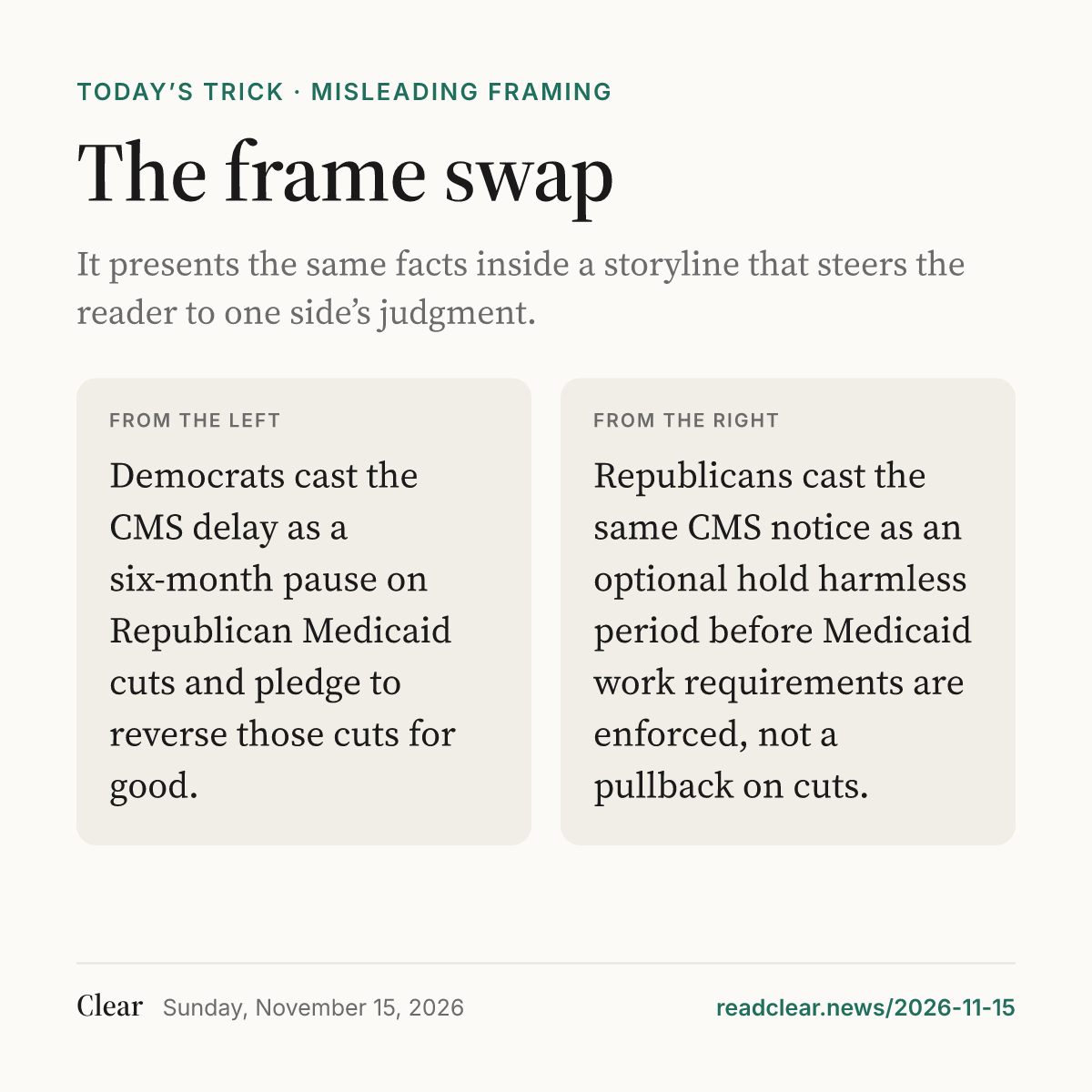
The frame swap
It presents the same facts inside a storyline that steers the reader to one side’s judgment.
From the left
Democrats cast the CMS delay as a six-month pause on Republican Medicaid cuts and pledge to reverse those cuts for good.
Story 2 · CMS delays Medicaid work-requirement enforcement six months →
From the right
Republicans cast the same CMS notice as an optional hold harmless period before Medicaid work requirements are enforced, not a pullback on cuts.
Story 2 · CMS delays Medicaid work-requirement enforcement six months →
One technique a day, one example from each side, in our words. Share the card
That’s the edition.
How we pick stories and what each label means: How we work · Balance ledger · Corrections
Get the edition by email, the morning it’s published.
Free. Unsubscribe anytime. Or read it in the app: 