 Clear
Tuesday, November 24, 2026
The day in 5 stories
Each story three ways: what happened, how it’s sold, and how it works. Every claim says what kind of claim it is:
on the record · widely reported · one side’s claim · unknown
-

Jensen Huang, founder and CEO of Nvidia, during a fireside chat in Stanford University's CS 153 course on April 30, 2026. Photo: Anderseidesvik · CC BY-SA 4.0 Nvidia board reinstates Jensen Huang as CEO
Nvidia’s board reinstated Jensen Huang as president and chief executive on November 22, effective immediately, the company told the SEC. The board said it received input from senior U.S. government officials and was confident the move posed no national security risk. President Trump said he spoke to the board and convinced it to reverse course.
Why it matters. Huang again directs day-to-day decisions at Nvidia under federal rules that limit advanced AI chip exports. Lawmakers can still summon him and write those rules into statute. Shareholders and employees return to his leadership while the board’s independent investigation continues.
3 on the record 1 one side’s claim 3 unknown
-
Trump orders faster federal death sentence enforcement
President Donald Trump signed a November 23 memorandum directing the attorney general to expedite federal death sentences and seek the death penalty in certain murder cases. That day he criticized California Gov. Gavin Newsom’s plan to commute state death sentences.
Why it matters. Justice Department is directed to speed post-conviction work on federal death sentences and seek capital charges in murders of minors and killings tied to rape, kidnapping, or trafficking. California’s 382 condemned persons needing state Supreme Court approval would move to life without parole if commutations take effect.
3 on the record 3 unknown
-
Commerce adds Megaspeed to export Entity List
The Bureau of Industry and Security added seven companies in Malaysia, Singapore and Thailand, including Megaspeed International, to the Entity List. The rule cited a significant risk of diverting advanced computing goods to unauthorized end uses or users. Exports of items subject to U.S. export rules to those firms now need a license, reviewed under a presumption of denial.
Why it matters. U.S. companies that export or reexport controlled goods need a Commerce license before shipping to the seven listed firms. Applications face a presumption of denial. That stops ordinary sales of advanced computing hardware to those companies unless Commerce grants a license.
3 on the record 2 one side’s claim 3 unknown
-
DOJ awards $149 million to hire 1,022 officers
The Justice Department on November 23 awarded $149,138,203 under the COPS Hiring Program, a grant for local officer pay, funding 1,022 new or rehired full-time sworn officers and deputies at 269 agencies. The awards cover entry-level salaries and fringe benefits for state, local, tribal, and territorial agencies. The department received 551 requests and selected about 49 percent of applicants.
Why it matters. Winning police and sheriff agencies receive federal money covering up to 75 percent of entry-level pay and benefits for each of 1,022 sworn positions over three years. Those agencies and the residents they serve get the hiring capacity the grants fund, with a local cash match required unless waived.
5 on the record 3 unknown
-
Court orders Defense to preserve Project Meridian records
A federal judge ordered the Defense Department, Secretary Pete Hegseth and Project Meridian participants to preserve all Project Meridian records while a lawsuit continues. Watchdog groups say the future-warfare panel was created outside the Federal Advisory Committee Act, which requires public notice, open meetings and balanced membership for federal advisory panels. The order does not decide whether that law applies.
Why it matters. Preservation keeps the panel’s minutes, drafts, emails and meeting notes available for the lawsuit over whether the Federal Advisory Committee Act requires public access. The panel is due to recommend weapons and technology priorities to the secretary by January 28, 2027.
4 on the record 3 unknown

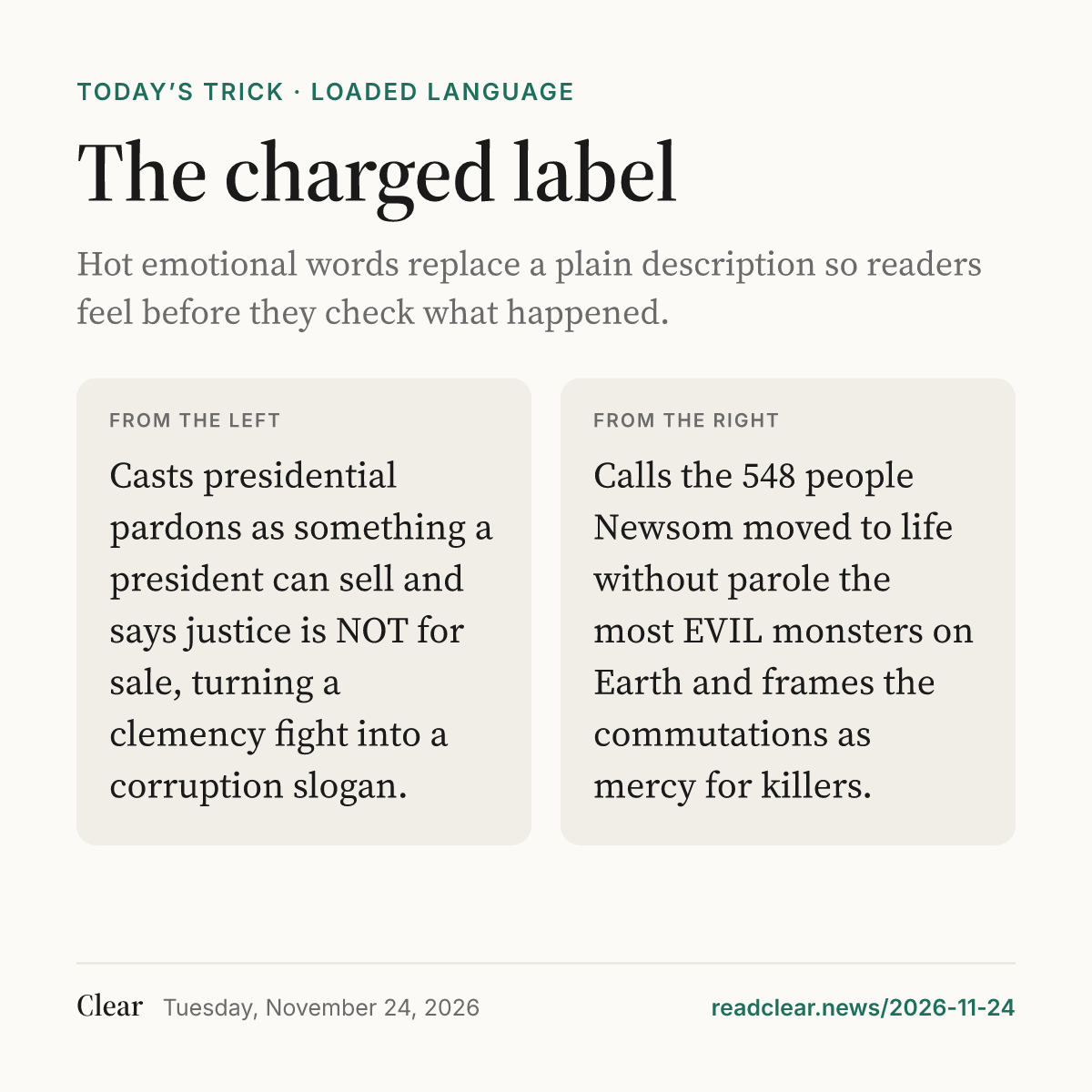
Today’s trick · loaded language
The charged label
Hot emotional words replace a plain description so readers feel before they check what happened.
From the left
Casts presidential pardons as something a president can sell and says justice is NOT for sale, turning a clemency fight into a corruption slogan.
Story 2 · Trump orders faster federal death sentence enforcement →
From the right
Calls the 548 people Newsom moved to life without parole the most EVIL monsters on Earth and frames the commutations as mercy for killers.
Story 2 · Trump orders faster federal death sentence enforcement →
One technique a day, one example from each side, in our words. Share the card
That’s the edition.
How we pick stories and what each label means: How we work · Balance ledger · Corrections
Get the edition by email, the morning it’s published.
Free. Unsubscribe anytime. Or read it in the app: 